VEHICLE HOMOLOGATION : JAPAN
Vehicle certification systems in Japan
There are 3 vehicle type approval systems in Japan as follows:
1. Type Designation System (TDS)
2. Preferential Handling Procedure (PHP)
3. Parallel Import (PI)
Type Designation System (TDS)
The TDS is suitable to high-volume production cars.
1.All the Japanese OEMs use TDS.
2.Major car importers also use TDS.
3.Plant audit is periodically conducted by Japanese Type approval authorities.
4.Many UNECE certificates are accepted by J-TAA.
Preferential Handling Procedure for Imported Motor Vehicles (PHP)
The PHP is suitable to middle-volume production cars and motorcycles (>250cc).
1.In case of ICE or Hybrid, TRIAS-WLTC test report is required to submit at a rate of 1/50 or 1/100.
2.Plant audit is not required.
3.Many UNECE certificates are accepted by J-TAA.
Parallel Import (PI) (also known as 1 of 10)
The PI is suitable to small volume cars and motorcycles (>250cc).
1.In case of ICE or Hybrid, TRIAS-WLTC test is required to be performed at a J-TAA designated lab in JAPAN for each vehicle. However, the test result may be used
for in maximum 9 others vehicles if the specification of those vehicles is exactly the same as that of the first vehicle.
2.PI is the approval for the individual vehicle.
3.The TAA for PI is the local Land Transport Office.
To which authority should the application be submitted ?
TDS and PHP:
•Ministry of Land, Infrastructure, Transport and Tourism MLIT
•National Traffic Safety and Environment Laboratory NTSEL
PI:
•Local Land Transport Office
Technical Requirements
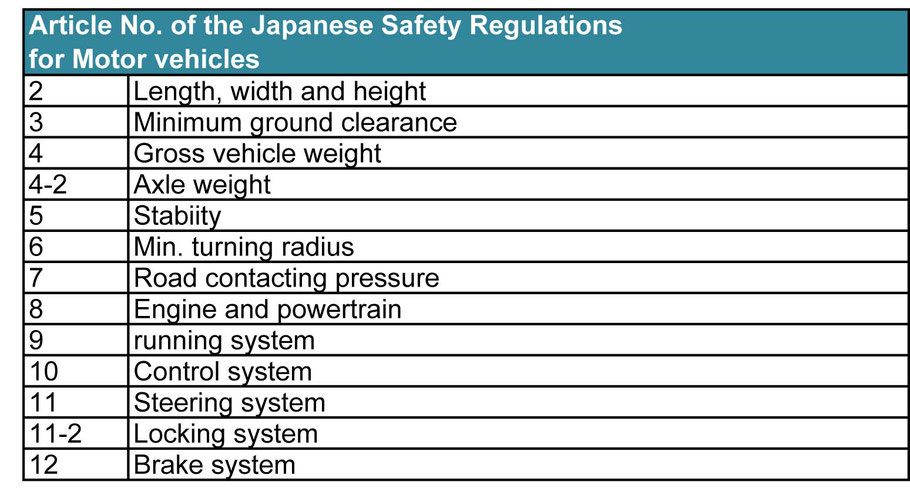
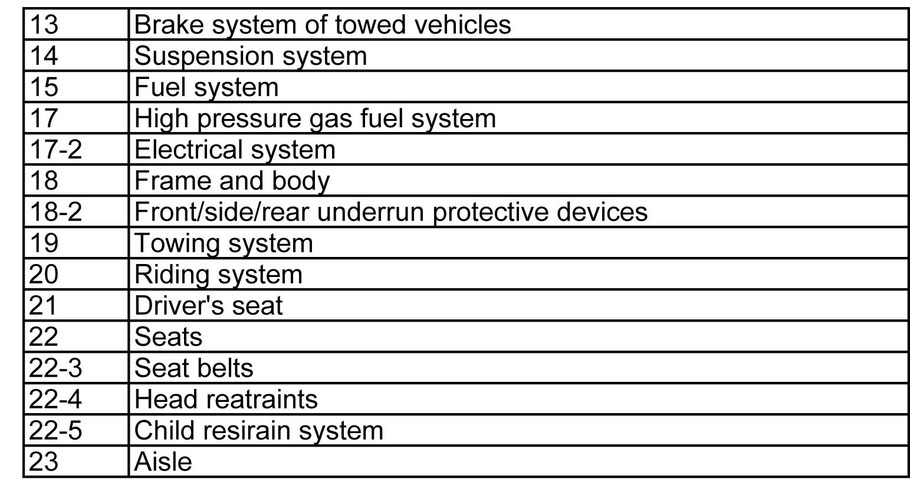
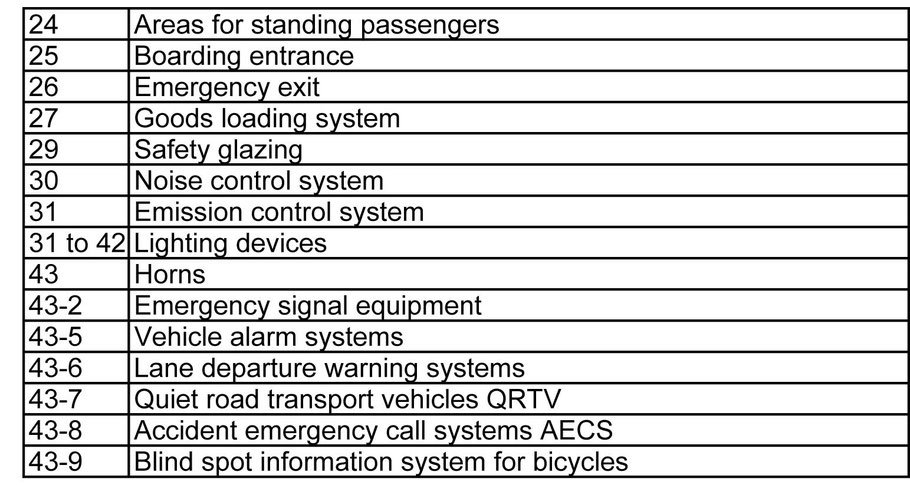
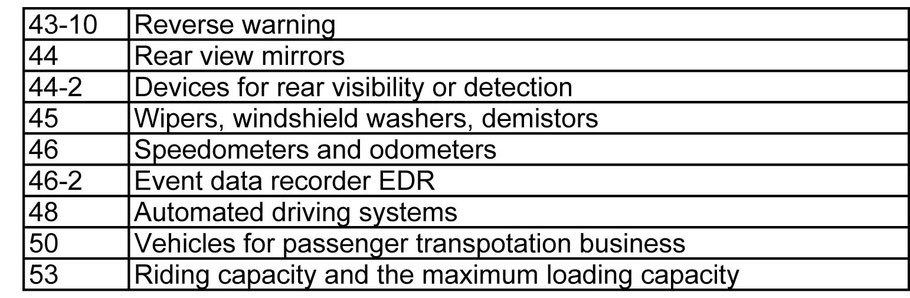
Motor vehicles have to fulfill the Japanese Safety Regulations as shown in the next list: (Source: MLIT)
UNECE regulations Japan adopted:
Japanese authorities adopted a certain number of the UNECE regulations. See the table attached. (Source:
MLIT)
Those UNECE approvals can be effective in the Japanese certification.
| No | Items | No | Items |
|---|---|---|---|
| 0 | IWVTA | 104 | Retro-reflective markings |
| 3 | Retro-reflecting devices | 110 | CNG and LNG vehicles |
| 4 | Registration plate lamps | 112 | Asymmetrical passing-beam headlamps |
| 6 | Direction indicators | 113 | Symmetrical passing-beam headlamps |
| 7 | Position and stop lamps | 116 | Anti-theft and alarm systems |
| 10 | EMC | 117 | Tyres, rolling resistance, noise, wet grip |
| 11 | Door latches/hinges | 119 | Cornering lamps |
| 12 | Steering mechanism | 121 | Controls and telltales |
| 13 | Heavy vehicle braking | 123 | Adaptive front-lighting systems |
| 13H | Braking (M1 and N1) | 125 | Forward field of visions of drivers |
| 14 | Safety belt anchorages | 127 | Pedestrian safety |
| 16 | Safety belts | 128 | LED light sources |
| 17 | Seat and their anchorages | 129 | Enhances child restraint systems |
| 19 | Front fog lamps | 130 | Lane departure warning systems |
| 21 | Interior fittings | 131 | Advanced Emergency Braking Systems AEBS |
| 23 | Reversing lamps | 134 | Hydrogen fuel cell vehicles HFCV |
| 25 | Head restraints | 135 | Pole side impact |
| 26 | External projections | 136 | Electric vehicles (L-cat) |
| 27 | Advanced warning triangles | 137 | Full frontal impact |
| 28 | Audible warning devices | 138 | Quiet road transport vehicles QRTV |
| 30 | Tyres (passenger cars) | 139 | Braking assist systems BAS |
| 34 | Prevention of fire risks | 140 | Electronic stability control systems ESC |
| 37 | Filament light sources | 141 | Tyre pressure monitoring systems TPMS |
| 38 | Rear fog lamps | 142 | Tyre installation |
| 39 | Speedometer | 144 | Accident emergency call systems AECS |
| 41 | Noise (L-cat) | 145 | ISOFIX anchorage systems |
| 43 | Safety Glazing | 146 | Hydrogen fuel cell vehicles (L-cat) |
| 44 | Child restraint system CRS | 148 | Light signalling devices |
| 45 | Headlamp cleaners | 149 | Road illumination devices |
| 46 | Devices for indirect vision | 150 | Retro-reflective devices |
| 48 | Lighting device installation | 151 | Blind spot information system for bicycles |
| 50 | Position, stop, DI (L-cat) | 152 | Advanced emergency braking systems AEBS |
| 51 | Noise (M and N-cat) | 153 | Rear end collision |
| 53 | Light installation (L3-cat) | 154 | WLTP |
| 54 | Tyres (Commercial vehicles) | 155 | Cyber security |
| 58 | Rear underrun protective devices | 156 | Software update |
| 60 | Driver operated controls (L-cat) | 157 | Automated lane keeping systems ALKS |
| 62 | Anti-theft (L-cat) | 158 | Devices for rear visibility or detection |
| 64 | Temper/Run-flat tires | 159 | Moving off information system |
| 66 | Superstructure (buses) | 160 | Event data recorder EDR |
| 70 | Rear marking plates (long vehicles) | 161 | Devices against unauthorized use |
| 73 | Lateral protection devices LPD | 162 | Immobilizers |
| 75 | Tyres (L-cat) | 163 | Vehicle alarm systems |
| 77 | Parking lamps | 165 | Reverse warning |
| 78 | Braking (L-cat) | 166 | Vision in front and side close proximity |
| 79 | Steering equipment | 167 | Direct vision |
| 80 | Seats and their anchorages (buses) | 168 | Global real driving emissions |
| 81 | Rear view mirrors (L-cat) | 169 | EDR for heavy vehicles |
| 85 | Measurement of Net power | 170 | CRS for buses |
| 87 | Daytime running lamps | 171 | Driver Control Assistance System DCAS |
| 91 | Side-marker lamps | 172 | Traction/snow retreaded tyres |
| 93 | Front underrun protective devices | 173 | Seat belts / CRS installation |
| 94 | Off-set Frontal collision | 174 | Seat belt reminder |
| 95 | Lateral collision | 175 | Accel. Control for Pedal Error ACPE |
| 98 | Gas-charge headlamps | 176 | Field of vision assistant systems |
| 99 | Gas-charge light sources | 177 | Determine system power |
| 100 | Electric power trained vehicles | 178 | Emergency Lane keeping systems ELKS |
If you have questions, feel free contact us at [email protected].